Welp… Had my 10th emotional breakdown last week. Now I’m prepping for my next one.
Remember the “good old days” in school where you didn’t have Google to help you with your papers? I sure do. I remember like it was yesterday sitting at the kitchen table using my parent’s Brother electric typewriter trying to pull together my high school book report on Wuthering Heights. Later in college I struggled learning to use a computer trying to interpret Dante’s Inferno before the computer lab closed.
I was a part of the technology boom. What a time to be alive… even though it created my own personal hell.
20 years later, I’m back in school and even more has changed. Online school can be so isolating. Discussion questions feel impersonal, but I’m still learning. Not having a classmate to bounce ideas off of or have debates on subject matter is something I miss. There are so many tools at our fingertips, such as digital libraries, online tutoring, and writing assistant tools. Now there is artificial intelligence, which we are required to use.
I use AI daily in my personal life and professional life. I create meal plans, my weekly schedules down to the half hour; I even get help to train my feral dog to stop barking like a hyena when a bird lands in his backyard. In my business life, I use it to help me build out timelines, confirm complex excel formulas, or make a slide I created look better.
I even asked AI to create a curriculum for me to learn about AI!
In this blog, I used AI to create an image of myself that combined the chaos of the characters in Absolutely Fabulous with the personal growth and learning experience of Rodney Dangerfield in Back to School. Yes. That image was intentional and not a real photo of me, despite how great that big hair and gold top look.



So why am I so terrified of using it in my academic life?
It’s the moral dilemma of the “grey area” of AI.
I’m required to use AI in this class I’m in now. I’m learning the ethicality of using it and ensuring that I’m clearly citing where I used it in my writing. But I’m paralyzed at the thought of actually using it. I’m paying a considerable amount of money for this MBA. Having a computer earn it would seem to defeat the purpose.
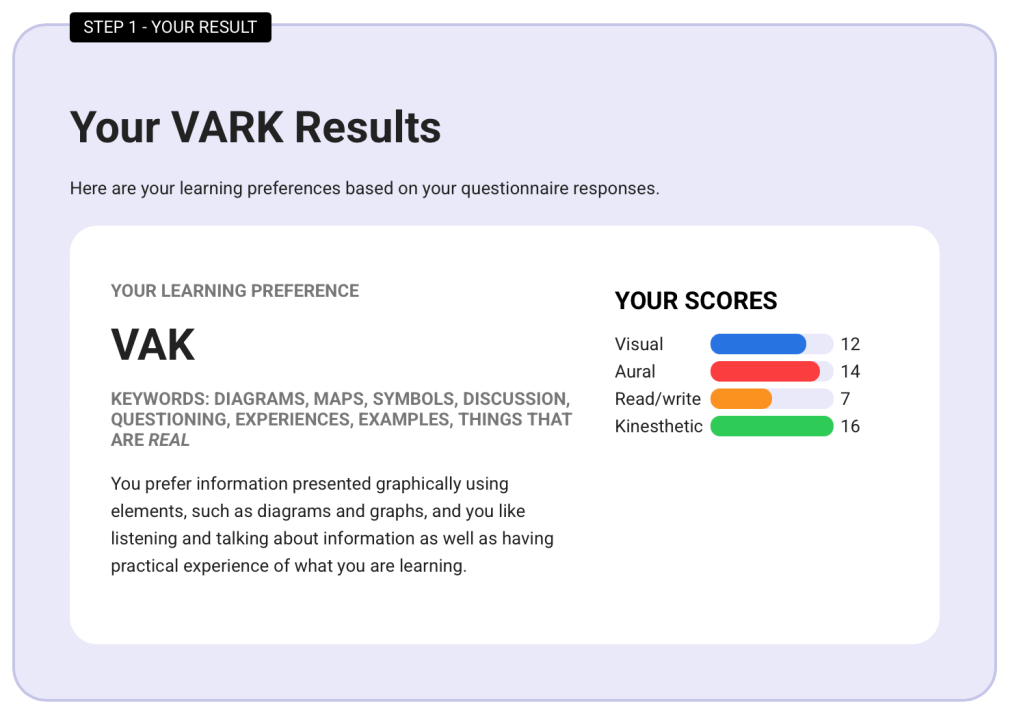
I recently completed a VARK learning assessment and it confirmed what I already know about myself: I’m a visual and aural learner that needs practical, real-life examples. Give me a diagram, conversation, example, or something I can interact with, and I’ll master it. Give me several pages of dense academic writing and there’s a reasonable chance I’ll reach the bottom of page four and realize I haven’t retained a thing.
So, it made sense that I printed out a dense article that was a physical, tangible document. I read it, used multiple colors of highlighters at key details, wrote my thoughts in the margins; but I didn’t feel like I had absorbed the study very well. And then the lightbulb turned on. I should ask AI to build an infographic that visually represented the study and its findings!
Wait. Was I allowed to do that?
That’s where the 8th breakdown happened…
There’s an obvious line that I don’t find particularly confusing. Asking AI to read an assignment and write my response for me isn’t learning. It is outsourcing the very thinking I’m supposed to be developing. It’s definitely cheating.
But what about asking AI to teach something that fits my learning style?
If I ask it to explain a statistical concept using a visual example, is that cheating, or tutoring?
And then there’s an even murkier area: using AI to organize ideas, challenge my reasoning, identify gaps in an argument, or tell me that the paragraph I’ve rewritten fourteen times still doesn’t make sense. Where’s the line that it becomes a crutch vs your own logical, critical thinking?
At what point does a tool stop helping me think and start thinking for me?
Maybe that’s the question I need to start asking.
Instead of “Did I use AI?”, perhaps the more meaningful question is “Who did the intellectual work?”
Did I read the material? Yes.
Do I understand it? Mostly.
Can I explain it without AI sitting next to me? Eventually.
Are the conclusions actually mine? Yes.
Did AI help me get there, or did it get there for me? … Yes?
Was my instructor traumatized when I came to her (breakdown #9)? Absolutely.
I don’t have this completely figured out yet. Ironically, learning how to use AI responsibly may turn out to be part of what I’m learning in graduate school: making ethical, informed business decisions.
Which feels appropriate.
After all, I’m pursuing an MBA in a world where artificial intelligence is rapidly becoming part of how businesses operate. Pretending it doesn’t exist wouldn’t prepare me very well for that world.
But letting it do the thinking for me wouldn’t prepare me for it either.
Apparently, somewhere between those two extremes is another thing I need to learn.
As if my upcoming stress over statistics wasn’t enough.
This reflection is the author’s work. AI was used to create custom images only.


Leave a comment